
EXIGENCE
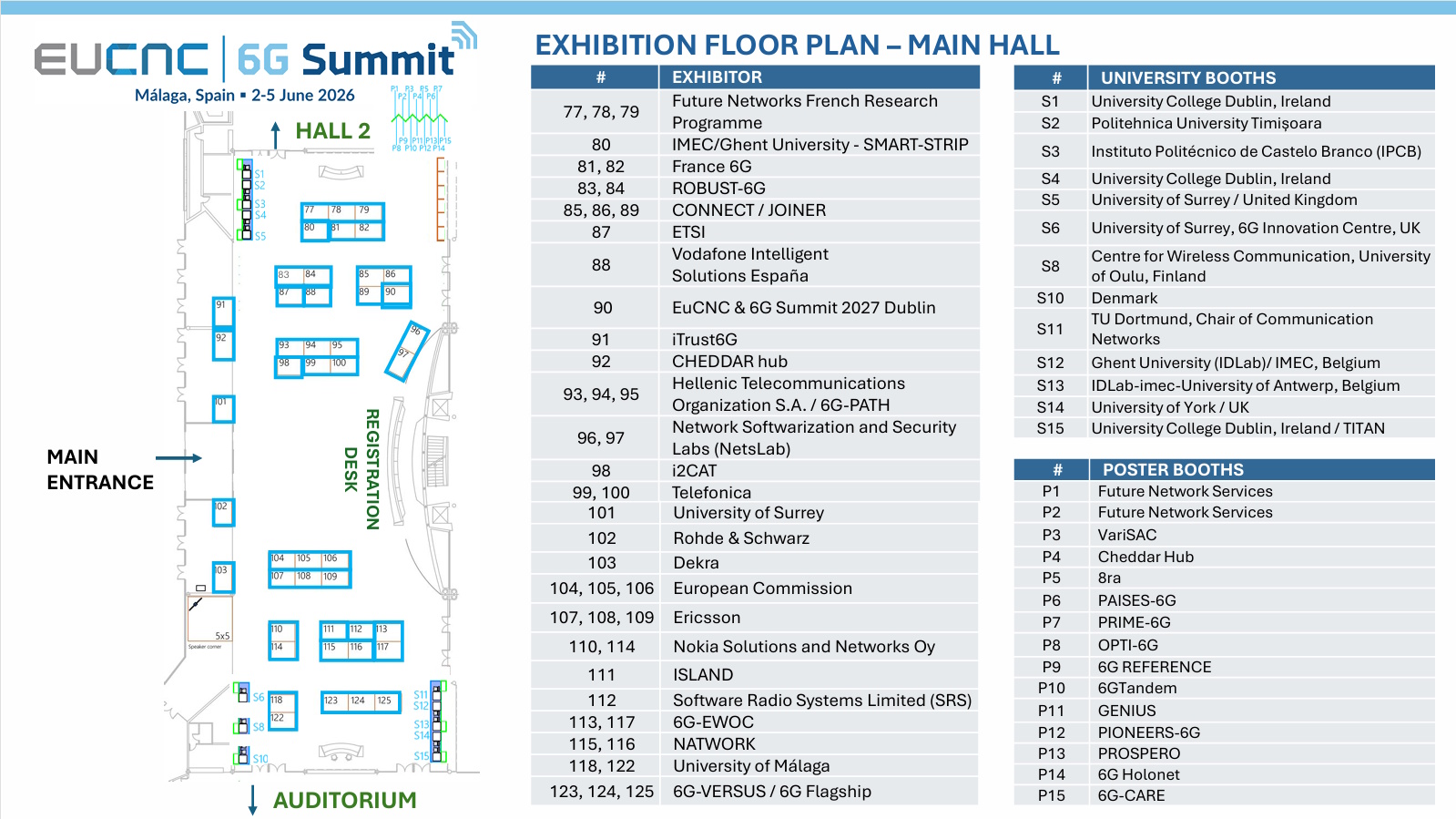
The rapid growth of 5G/6G networks demands a shift from isolated optimisations to a systemic, end-to-end approach for reducing ICT carbon footprints. The EXIGENCE project addresses this by integrating network-level efficiency with user awareness. This demonstration showcases a holistic architecture that tracks real-time carbon metrics for services like video streaming and AI/LLM inference, using data to drive load balancing between high-performance and eco-friendly variants. Beyond backend optimisation, the demo illustrates how transparent eco-data and incentive mechanisms – such as ‘eco-points’ – can empower sustainable user behavior without compromising performance.

MARE
MARE (Programmable, Modular and Disaggregated Security Plane for 6G Ecosystems) is an SNS-JU initiative dedicated to establishing a unified, proactive security framework for the next generation of mobile networks. As 6G architectures shift toward highly distributed, virtualized and disaggregated environments, MARE addresses the expanded attack surface by introducing a security plane built on “atomic” security primitives (DOTs) that can be dynamically composed into modular Security Functions (SFs). By integrating advanced Artificial Intelligence, Intent-Based Networking (IBN) and a specialized Preassessment Stress Testing Environment (PASTE) utilizing Network Digital Twins, the project enables security orchestration that can predict and mitigate threats before they impact the live infrastructure. Ultimately, MARE ensures end-to-end resilience, data privacy and system integrity across the entire 6G landscape – from the core to the extreme edge, fostering a trustworthy digital ecosystem for European industry and society.

Cogninn
Cognninn develops virtualized and intelligent 6G mobile networks.
MultiX-6G / PRIME-6G
The MultiX project aims to revolutionize the 3GPP Radio Access Network (RAN) design and operation by developing a pioneering MultiX fusion Perceptive 6G-RAN system (MP6R) that will support an integrated multisensor, multi-static, multi-band, and multi-technology paradigm to enable multi-sensorial perception for future 6G sensing applications. To fully address the 6G Sustainability goals, MultiX will explore AI’s full potential across all layers of the MP6R and develop an energy efficient AI architecture for adaptive ISAC transmitter/receiver and distributed learning with a novel low power AI engine design.
PRIME-6G (Pilot for Resilient Industrial Manufacturing Environments with 6G Technologies) addresses the enablement of key 6G technologies in advance manufacturing vertical industries towards production batch one. The Project Will develop and validate an integrated E2E Sustainable Platform Blueprint integrated 6G architecture base don a Cloud-Edge Continuum, enabling seamless and agile service provisioning.
ORIGAMI
ORIGAMI aims at spearheading the next-generation of mobile network architecture, overcoming eight factual barriers to ensure a successful 6G future. With three critical architectural innovations – Global Service-based Architecture (GSBA), Zero-Trust Exposure Layer (ZTL), and Compute Continuum Layer (CCL) – ORIGAMI strives to create global single standards, promote green transition, boost affordability and accessibility, and inspire ground-breaking applications and fresh business models.
TERRAMETA
Reconfigurable Intelligent Surfaces (RIS) have emerged as a key enabling technology to overcome these challenges by actively shaping the wireless propagation environment. However, most RIS demonstrations remain confined to static laboratory setups and do not yet address realistic, mobile, data‑intensive use cases.
This demonstration addresses that gap by showcasing a live, operational 140 GHz RIS‑assisted wireless link integrated with a real robotic platform. High‑bandwidth 3D point‑cloud sensor data is transmitted wirelessly over the THz link and processed in real time to support the use of AI digital twin pipelines at the edge. The demo highlights how RIS‑enabled THz communications can move beyond theory into deployable, application‑driven 6G systems.

6G-DISAC
The 6G-DISAC project develops and validates Distributed Intelligent Sensing and Communication (DISAC), a 6G paradigm where heterogeneous nodes cooperatively sense the environment and combine distributed processing with adaptive radio sensing and AI/ML-driven orchestration. Moving beyond connectivity, 6G-DISAC enables context-aware services where networks act as both communication and perception platforms. The project delivers key innovations to make distributed ISAC practical and scalable. It optimizes adaptive waveforms and physical-layer parameters for sensing and localisation, including AI-native cooperative designs leveraging reconfigurable intelligent surfaces (RIS). Advanced receiver-side inference enables real-time distributed localisation, tracking, and mapping of passive objects and users. Sensing information is tightly integrated into communication functions, enhancing beam management, handover, and full-duplex operation. In parallel, protocols and orchestration mechanisms coordinate heterogeneous sensing roles, reduce overhead, and enable learning-based operation. By combining sensing, communication, and intelligence, 6G-DISAC paves the way for safer, more efficient, and sustainable 6G applications.

SLICES-RI
SLICES is a flexible platform designed to support large-scale, experimental research focused on networking protocols, radio technologies, services, data collection, parallel and distributed computing and in particular cloud and edge-based computing architectures and services.
EU SNS-JU 6G-Cloud
The EU SNS-JU 6G-Cloud project researches, develops and validates key technologies to achieve an AI-native and cloud-friendly 6G system architecture on top of the cloud continuum. It goes beyond current 5G architecture design by introducing a service-oriented architecture across a multi-stakeholder cloud environment spanning from extreme edge to central clouds. The 6G-Cloud architecture develops an end-to-end Service-Based Architecture that extends beyond the Core into the Radio Access Network and management domains. The design unifies the Network Services, Management and Orchestration Framework, Cloud Continuum Framework and AI/ML Framework through standardized interfaces deployed across the Cloud–Edge–Far-Edge continuum.

AMBIENT-6G
Limited autonomy of battery-powered IoT devices drives up maintenance costs, increases system complexity, and compromises long-term reliability. AMBIENT-6G overcomes this by evolving the concept of Ambient-IoT (AIoT). A-IoT devices harvest energy or leverage RF wireless power transfer, enabling decades-long operation without battery replacements. However, the tiny energy budget introduced by energy harvesting poses significant operational challenges. AMBIENT-6G aims to solve these by innovating in three main areas: (i) a holistic hardware/software low-power A-IoT device architecture, (ii) a 6G network that enables low-power active and passive connectivity, as well as wireless power transfer, and (iii) A-IoT integration into the device-edge-cloud continuum.
6G-SENSES
Emerging 6G Radio Access Network (RAN) technologies pose challenges in energy efficiency, power consumption, and communication, particularly at high data rates. The EU-funded 6G-SENSES project aims to address these challenges by integrating innovative 6G RAN technologies, such as Cell-Free (CF),
Massive Multiple-Input Multiple-Output (MIMO), and Integrated Sensing and Communication (ISAC), to establish a multi-technology RAN ecosystem with sensing capabilities. Within this framework, Sub-6, WiFi, millimetre-wave, and 5G NR technologies will coexist, enabling the retrieval of comprehensive environmental information to enhance energy efficiency and facilitate high data rate communication. Leveraging Reconfigurable Intelligent Surfaces (RISs), the project will improve availability and sensing performance, incorporating distributed signal processing and resource allocation schemes optimised for RIS-assisted CF network architecture.

CONVERGE
The CONVERGE project develops a novel toolset under the vision of “view-to-communicate and communicate-to-view”, enabling tight integration between sensing, perception, and wireless communications. The project brings together vision-aided large intelligent surfaces, vision-enhanced base stations (fixed and mobile), a radio-vision simulator with 3D environment modelling, and machine learning methods for multimodal data fusion, including radio signals, video, RF sensing, and traffic data. This integrated approach addresses key challenges in 6G systems, where communication networks are expected to become context-aware, adaptive, and tightly coupled with their surrounding environment. By combining sensing and communication, CONVERGE enables new capabilities such as environment-aware networking, improved localization, and enhanced situational awareness.

iSEE-6G
Joint/Integrated Communication and Radar/Radio Sensing (JCAS/ICAS) unifies wireless communication and environmental sensing by using shared radio signals to transmit data and detect objects, motion, and relative location. Joint Communication and Sensing (JCS) enables networks to simultaneously exchange information and perceive their surroundings. Building on this concept, iSEE-6G proposes a Joint Communication, Computation, Sensing, and Power transfer (JCCSP) unified radio platform. It integrates advanced 6G technologies to support edge computation through task offloading, enabling efficient processing of complex or energy-intensive functions via cooperation and data fusion. Additionally, it incorporates RF-based wireless power transfer to deliver energy to devices without physical connections.
INSTINCT
The INSTINCT project is aimed at enabling globally sustainable, interactive, immersive, and intelligent ‘beyond communications’ 6G connectivity by developing three complementary but critical breakthrough technology pillars:
PILLAR I – “Sense-to-communicate”: to improve radio spectrum usage by leveraging sensing information
PILLAR II – “Communicate-to-sense”: to transform the wireless network into a smart ‘sense the world’ platform, capable of providing JCAS (Joint Communication and Sensing) -as-a-service functionalities
PILLAR III – Multi-functional JCAS Network Intelligence: to optimise the architecture, resources, propagation and waveforms aided by AI for wireless JCAS systems.
INSTINCT aspires to deliver the theoretical framework and relevant Key Performance Indicators (KPIs), waveforms, protocols and hardware (HW) design of an innovative beyond communications 6G architecture, leveraging Reconfigurable Intelligent Surfaces (RIS) and AI / ML (artificial intelligence/ machine learning). INSTINCT, by means of its 3 pillars is establishing the foundations for a new ICST (Information Communications and Sensing Technologies) era, where IoT meets ICT.

OAIBOX
OAIBOX is a powerful, GPU-accelerated open-source testbed, designed to enable 5G/6G advanced research and real-world experimentation. It integrates a complete 5G stack, including gNB, 5G Core, and UE, within a single compact system, simplifying setup and operation. The platform features a high-performance NVIDIA GPU, supporting demanding edge AI training and real-time inference.
With its intuitive OAIBOX dashboard, users can easily control, orchestrate, and monitor the network in real time. Additionally, it supports GPU partitioning via NVIDIA MIG and enables real-time digital twin simulations using NVIDIA Sionna Ray Tracer, offering a flexible and scalable environment for AI-native 6G research.
6G-BRICKS
6G-BRICKS brings together specialists on breakthrough 6G technologies, such as cell-free networking, distributed processing and Reconfigurable Intelligent Surfaces (RIS), and adopting principles of modularity and softwarization to deliver the first truly modular end-to-end 6G experimentation platform in Europe. 6G-BRICKS will structure the various architecture tiers around the concept of “LEGO Bricks”, delivering self-contained testbed nodes that can be reused across testbed infrastructures. This significantly lowers the barrier of entry to an end-to-end experimentation platform for specialists to bring their breakthrough technologies for validation and experimentation.

6G-DALI
6G-DALI proposes a novel e2e AI framework that aims to connect 6G data with verticals and ML developers and experimenters, while relying on 6G testbeds selected from the flagship SNS C phase 2 (SUNRISE-6G) project. To this end, 6G-DALI is bringing together 3 communities; experts on the design and experimentation on 6G systems, experts on AI and MLOps with a good mix of industry and academic experience, and finally experts on DataOps and the Gaia-X community, that all collaborate for the first time to build an efficient, realistic, and trustworthy framework for e2e AI/ML experimentation for 6G.
6G Platform Germany
The German Platform for Future Communication Technologies and 6G Enabling Digital Sovereignty for the Citizens in a Hyperconnected World
BubbleRAN
BubbleRAN helps organizations seamlessly build, operate, and automate private 4G/5G networks and service infrastructure—from lab to production. We combine standards-compliant O-RAN with cloud-native and AI-powered automation to deliver step-change flexibility and efficiency at scale. With deep expertise across 4G/5G systems, cloud-native operations, and intelligent network optimization, BubbleRAN is the trusted partner to accelerate your telco transformation.

6G-INTENSE
6G-INTENSE proposes a new System Architecture for 6G, to deliver “6G as a Smart Service Execution platform”, fully in line with the vision of sustainable infrastructure sharing to reduce space and energy costs, and encouraging collaboration among all members of the value chain under a unified Network-Compute fabric. Key contribution is a novel automation architecture with a Native AI toolkit facilitating intent declaration, negotiation and decision automation across autonomous domains, termed as Distributed Intent-driven Management and Orchestration (DIMO). Moreover, Sensing is adopted as a key enabler, helping navigate the complexities and lack of reliability of the Deep Edge.
FLECON-6G
FLECON-6G presents the “intelligent 6G Network of Networks” vision with Trustworthiness and Generalisability of Native AI and NDT-assisted approaches considered as key objectives. FLECON-6G aims to deliver key assets in the form of collaborative and distributed frameworks offering scalability and support for multi-domain, multi-stakeholder infrastructures, jointly with network infrastructure programmability that supports the offloading of network application logic.

ADROIT-6G
ADROIT6G’s aims to provide revolutionary research foundations for low TRL technology advancements in preparation for the upcoming 6G network architectures. In particular, to evolve the existing service-based architectures (SBA & SBMA) of 5G mobile networks, and design, implement and validate a fundamentally new approach for a future-proof, cognitive, next-generation 6G architecture by adopting a fully distributed AI-driven dynamic paradigm, with functional elements automatically deployed on-demand as virtual functions in cloud-native environments, across the far-edge, edge and cloud domains, operated by different stakeholders. This will ultimately lead to improved performance, higher level of control, increased transparency in interactions with digital services, true support of future-looking applications and social acceptance.

SUNRISE-6G
SUNRISE-6G is a scalable, open and standards-compliant approach to experimentation and vertical application deployment in a pan-European Federation of 6G infrastructures, that provides access to a comprehensive library of 6G enablers. This approach, leveraging and extending APIs from the Camara Initiative and GSMA OPG, provides a clear roadmap to 3GPP compliance and future Stream-D deployment. To this end, key participants from Stream C Phase-1 projects, Other SNS Phase 1 and National 6G initiatives, and SLICES-RI, as well as industrial partners with a proven standardization record and participation in the Camara Initiative, joined forces to co-develop, deploy and test the SUNRISE-6G solution.
NexaSphere
NexaSphere is a Horizon Europe research and innovation project focused on designing and validating a unified three-dimensional (3D) communication network. It explores the integration of terrestrial (TN), non-terrestrial (NTN), and aerial systems to support future mobility and connectivity needs across aviation, automotive, and rail sectors. The project investigates architecture, orchestration, and technology components, with validation carried out through three domain-specific proof-of-concept demonstrations.
Open6G+AI
The Institute for Intelligent Networked Systems (INSI) at Northeastern University is a transatlantic research nexus advancing the science and engineering of AI-native, networked systems that integrate communication, sensing, computation, and autonomy. Anchored by its hubs in Boston, USA and London, UK, INSI we showcase technologies developed under the flagship Open6G + AI program. AgentRAN, a framework for autonomous Radio Access Network management, ALLSTaR is a scheduler synthesis and testing framework and an AI-driven spectrum sensing and sharing system built on the O-RAN dApp framework, developed within the AI-RAN Alliance AI-for-RAN working group.

COREMAT-6G
COREMAT-6G is a project funded by the Spanish programme UNICO I+D. It deals with the development and integration of RIS technology into Radio Access Networks. The demo will showcase some of the project’s results and a live proof-of-concept of the application of chirp-based modulation schemes for pilotless ISAC systems in RIS-aided RAN configurations.

Imperial College London
This demonstration showcases research from three major UK initiatives: the Hub in All-Spectrum Connectivity, TITAN, and the EPSRC project Beyond Diagonal Phase Shift Matrices. The work focuses on next-generation communication systems that integrate wired and wireless technologies to enable seamless, high-capacity connectivity. It explores advanced signal processing and reconfigurable system design to support flexible, low-latency, and efficient networks. These developments contribute to future 6G systems and beyond, with potential applications in intelligent infrastructure, distributed computing, and advanced sensing.

Ranplan Wireless – TeraWireless
This demonstration showcases the integration of digital twin technology with Terahertz (THz) ultra-massive MIMO systems to enable Tbps data rates and sub-millisecond latency in future 6G networks. Exploiting the vast bandwidth of the THz spectrum, the system supports demanding applications such as AR/VR, holographic communications, autonomous systems, and smart manufacturing. A wireless digital twin continuously mirrors the physical THz network by collecting dynamic channel, multipath, and traffic data. It enables proactive beamforming, adaptive resource allocation, and energy-efficient optimization through closed-loop control and physics-aware learning. By combining THz communications with intelligent digital twin modeling, the demonstration illustrates how deterministic, ultra-high-performance 6G connectivity can be achieved.
Amazing6G
AMAZING-6G proposes a novel set of 15 use cases in the domains of Healthcare, Public Safety, Energy and Transport (including Rail) which will be showcased in large-scale trials and pilots across Europe.
Innovative technology enablers are planned to be developed and tested in the areas of Communications, Compute-as-a-Service, Applications and AI, IoT and localization. Security aspects will be taken into consideration in the development of solutions. Framed in this context, the significance of large-scale trials in B5G/6G networks lies not only in their ability to validate the technical capabilities of the technology but also in their capacity to unveil new use cases and applications that were previously inconceivable.

FIDAL – Field Trials Beyond 5G
Long-term towards Evolved 5G and 6G research needs mobilization of massive volumes of ideas, from which the best can emerge and be adopted for standardization. With the extremely low latency and huge data capacity of Beyond 5G and 6G networks, the cyber and physical worlds could converge, allowing for the development of services like digital twins and internet of senses applications. This future ecosystem is on track to be more collaborative and inclusive than previous generations of network. FIDAL seeks to set the standard by fostering open architectures, large experimentation sites, and adopting a multi-stakeholder approach, thus it steps in, targeting the augmentation of human capabilities, enabling Media & PPDR vertical industry players to carry out advanced technological and business validation in large-scale trial facilities of highly innovative and advanced applications, that take full advantage of Evolved 5G technologies.

ALLEGRO
ALLEGRO designs and validates an end‑to‑end sliceable, reliable, and secure architecture for next‑generation optical networks, targeting 10 Tb/s optoelectronic devices and 1 Pb/s fiber systems with >25% reductions in power consumption and cost. It is enabled by smart coherent transceivers exploiting multi‑band and multi‑fiber technologies for P2P/P2MP applications; low‑loss, energy‑efficient transparent photonic switches eliminating OEO conversions; an integrated security framework combining advanced QKD, post‑quantum cryptography, optical channel coexistence, and physically unclonable functions; and an AI/ML‑assisted control and orchestration system enabling autonomous networking, dynamic service provisioning, and efficient resource allocation through increased programmability and network softwarization.

F6S/6G-LEADER
6G-LEADER aims to support the RAN’s transition toward AI-empowered, spectrum-efficient, and open 6G networks, designing a flexible and intelligent architecture for enhanced wireless connectivity. The project will advances wireless communications and signal processing technologies enabling smarter, faster, and greener wireless systems built on openness, interoperability, and innovation.

TOAST
The TOAST Doctoral Network, funded by the European Union’s Horizon Europe research and innovation programme under the Marie Skłodowska-Curie Actions (MSCA) Doctoral Networks, focuses on the emerging interdisciplinary field of the Tactile Internet. By bringing together leading academic and industrial partners across six European countries, each contributing complementary expertise, the project aims to develop holistic, end-to-end solutions for touch-enabled Tactile Internet applications.

ENVELOPE
The ENVELOPE project aims to advance and open up the reference 5G advanced architecture, and also to transform it into a vertical-oriented with the necessary interfaces tailored to the CAM UCs that:
i) expose network capabilities to verticals,
ii) provide vertical-information to the network;
iii) enable verticals to dynamically request and modify certain network aspects in an open, transparent and easy to use way.
ENVELOPE delivers 3 large-scale B5G trial sites in Italy, the Netherlands and Greece, implementing functionalities tailored to CAM services, along with advanced exposure capabilities.

6G-GOALS
The 6G-GOALS project advances a semantic-aware vision for 6G networks, where communication is driven by meaning and task objectives rather than raw data transmission. Within its framework, a novel architecture enabling distributed intelligence across the RAN, edge, and core, allowing communication, computation, and control to dynamically adapt to application needs is proposed. The project establishes key theoretical and algorithmic foundations for semantic-aware, resource-efficient, and actionable communication, particularly suited to constrained environments such as robotic control and model delivery. It also defines a pathway toward cross-domain orchestration, aligning system behavior with semantic utility and application-level goals. These innovations are validated through Proofs of Concept on SDR and AI-enabled platforms, including a flagship demonstration in cooperative robotics, confirming feasibility and performance gains under realistic wireless conditions.
UNITY-6G
UNITY-6G is an SNS project focused on tackling energy efficiency and sustainability challenges in networked services.
The project leverages artificial intelligence, machine learning, and distributed ledger technologies to secure data exchange and foster trust between parties. It also explores various network access technologies, including non-terrestrial networks, non-public networks, and approaches like open radio access networks. The primary goal of UNITY-6G is to develop energy-efficient, integrated network infrastructures that support the convergence and interoperability of heterogeneous domains, such as wireless networking, IoT, and mobile and distributed computing.
SAFE-6G
SAFE-6G is a European research project (HORIZON-JU-SNS-2023-STREAM-B-01-04), which pioneers a holistic research approach, situating a native trustworthiness framework atop the open and distributed USN/NSN-based 6G core, leveraging (X)AI/ML techniques to coordinate user-centric safety, security, privacy, resilience and reliability functions, strategically optimizing the Level of Trustworthiness (LoTw) as a pivotal Key Value Indicator (KVI) for 6G, while addressing specific trust requirements and data governance policies specified by each user/tenant/human-role throughout the entire 6G lifecycle, encompassing onboarding, deployment, operation and decomposition. The SAFE-6G consortium comprises 13 organisations from 6 European countries, encompassing 4 large industrial companies, 6 innovative SMEs, 1 research institute and 2 universities.

ASELSAN/Military 5G MANET Data Link
Through a live demo supported by a channel emulator, we will be demonstrating
– Relay based communication performance
– Adaptive routing and self-forming /self-healing MANET behavior under topology changes
– System communication performance under jammer scenario and different conditions generated by channel emulator

6G-SANDBOX
6G-SANDBOX is a HE funded research project (HORIZON-JU-SNS-2022-STREAM-C-01-01). The 6G-SANDBOX project brings a complete and modular facility for the European experimentation ecosystem, which is expected to support for the next decade technology and research validation processes needed in the pathway towards 6G. The target is at technologies and research advances, that span over the entire service provisioning chain, and refer to user/data, control and management planes.

Keysight Technologies
At Keysight, we inspire and empower innovators to bring world-changing technologies to life. As an S&P 500 company, we’re delivering market-leading design, emulation, and test solutions to help engineers develop and deploy faster, with less risk, throughout the entire product life cycle. Whether you’re looking to accelerate 5G and 6G networks, autonomous vehicles, AI infrastructure, IoT, or quantum computing, our software-centric solutions serve across the design and development environment, enabling you to deliver tomorrow’s breakthroughs with more speed and less risk. With Keysight at your side, engineer with confidence in our connected and dynamic world. Innovation starts here.

Virginia Diodes
VDI manufactures state-of-the-art test and measurement equipment for mmWave and THz applications. These products include Vector Network Analyzer, Spectrum Analyzer and Signal Generator Extension Modules that extend the capability of high performance microwave measurement tools to higher frequencies. VDI’s component products include detectors, mixers, frequency multipliers and custom systems for reliable operation at frequencies between 50 GHz and 2 THz. All VDI components include in-house fabricated GaAs Schottky diodes and microelectronic filter structures.

MathWorks
MATLAB and Simulink are used as fundamental modeling and simulation tools for research and development wherever engineering and science is applied. More than 6,500 colleges and universities use MATLAB and Simulink for teaching and research. MathWorks products also help prepare students for careers in industry, where the tools are widely used for algorithm development, data analysis, visualization, and numeric computation.

ITRI
ITRI is a world-leading applied technology research institute with more than 6,500 employees. Its mission is to drive industrial development, create economic value, and enhance social well-being through technology R&D.
Founded in 1973, it pioneered in IC development and has been dedicated to nurturing new ventures and delivering its R&D results to industries. ITRI has incubated companies such as TSMC, UMC, Taiwan Mask Corp., Epistar Corp., Mirle Automation Corp., and Taiwan Biomaterial Co.
To remain at the forefront of innovation and address global challenges, ITRI focuses on the strategic R&D domains of Smart Living, Quality Health, Sustainable Environment, and Resilient Society, while enhancing Intelligentization Enabling Technologies to support these applications. The Institute strives to leverage technological innovations to inspire new lifestyles, engineer market-driven solutions, create uncontested spaces, and ultimately steer society toward a better future.

SUSTAIN-6G
SUSTAIN-6G is the Sustainability Lighthouse project that creates a holistic perspective on sustainability in the 6G ecosystem, by integrating environmental, social and economic pillars with both, sustainable 6G technology and 6G technology for sustainable vertical applications – with a focus on agriculture, smart grids and e-health. SUSTAIN-6G drives the “Sustainability by Design” approach towards end-to-end systems, considering the full lifecycle of assets and services, and develops the framework and methodologies to assess and evaluate sustainability effects of future communication technologies.

6G-TWIN
6G-TWIN aims to enable AI-native 6G systems by integrating Network Digital Twins (NDTs) for real-time optimisation, management, and control of future networks. It develops a reference architecture where digital replicas of network infrastructures support simulation, AI training, and pre-deployment validation of decisions. By combining AI, programmability, and distributed intelligence across the edge–cloud continuum, the project targets more efficient, adaptive, and sustainable networks. Demonstrations focus on teleoperated driving and energy optimisation. 6G-TWIN is funded by the Smart Networks and Services Joint Undertaking under the Horizon Europe programme (Grant Agreement No. 101136314).
ELASTIC
ELASTIC is a European project funded by SNS JU under Horizon Europe, addressing key challenges in 6G service orchestration across the cloud–edge continuum. Future 6G services will span highly distributed environments, from IoT devices and edge nodes to private and public clouds, requiring secure and efficient execution across heterogeneous platforms. ELASTIC introduces a novel framework that enables seamless execution from on-premise to edge and cloud by combining WebAssembly, eBPF, and Confidential Computing, supporting lightweight serverless deployment, real-time observability, and trusted execution. The approach is validated through two real-world demonstrators: a Smart Connected Factory and a privacy-preserving cloud migration scenario, demonstrating secure and scalable 6G services.

Future Networks French Research Programme
The French government opted to support R&D through a Priority Research Programme and Equipment (PEPR) on 5G, 6G and Networks of the Future. This program was launched in May 2023, for a 6-year duration, and is organized into 4 axes:
– Network architectures and services: new network architectures and infrastructures, communication convergence, cloud, sensing, orchestration of multi-sector services
– Technology building blocks: electronic and photonic components, signal processing
– End-to-End systems: security, environmental impact, IoT services for verticals, theoretical foundations to support network optimization
– Platforms and demonstrators on the platforms of the future: organizing the pooling of resources and opening them up to the scientific community and industrial partners, with the aim of carrying out end-to-end characterizations.
We aim at demonstrating some of our key results, after three years of project, during this flagship European conference.
IMEC/Ghent University – SMART-STRIP
SMART-STRIP aims at being the first to turn the new challenging multidimensional theoretical concept of cell-free distributed MIMO into a flexible, scalable and affordable E2E integrated solution that can be validated in realistic professional scenarios.
France 6G
The France 6G serves as the national platform missioned by the National Acceleration Strategy on 5G and Future Networks under the France 2030 plan coordinated by the french ministry. It acts as a strategic bridge between innovation and industrial standardisation of 6G technologies. The mission seeks three core objectives:
– capacity building and raising awareness across the ecosystem about the challenges to reach the next generation of networks
– support for the ecosystem and especially innovative SMEs and startups to link their innovations to the emerging technologies in standardisation.
– efforts in European collaborations, specifically within the Smart Networks and Services Joint Undertaking (SNS JU) and broader EU R&D programs, to ensure French leadership at a continental scale.
France 6G mission is hosted by Institut Mines-Télécom (IMT) and directed by Prof. Hakima Chaouchi. The national strategy on 5G and future networks which is coordinated by Charlotte Marelli from the french digital ministry.

ROBUST-6G
ROBUST-6G is a European research project (HORIZON-JU-SNS-2023-STREAM-B-01-04) that pioneers the development of data-driven, AI/ML-based security solutions, addressing the evolving challenges presented by the dynamic landscape of forthcoming 6G services and networks within the future cyber-physical continuum. Our mission encompasses not only advancing security measures but also safeguarding the integrity of AI/ML systems from potential security breaches and upholding the privacy rights of individuals whose data fuels these systems. ROBUST-6G initiative extends to the promotion of green and sustainable AI/ML methodologies, aiming to optimize energy efficiency in 6G network design.

JOINER
JOINER (Joint Open Infrastructure for Networks Research) is an international-scale, open experimental platform designed to accelerate research, development, and innovation in future communications networks. Led by the University of Bristol, JOINER brings together a federation of more than 15 laboratories and testbeds across the UK into a single, coordinated infrastructure.
By providing access to real-world, end-to-end environments, JOINER enables researchers, industry, and innovators to design, integrate, and validate advanced connectivity technologies under realistic conditions and at scale. The platform supports the full innovation lifecycle, from early-stage experimentation through to system-level validation and technology readiness.
Powered by emerging AI capabilities, JOINER advances key areas including end-to-end network solutions, intelligent network automation, telco cloud architectures, spectrum utilisation, security, and non-terrestrial networks (NTN). Through its open and collaborative model, JOINER strengthens the UK’s position as a global leader in next-generation connectivity, bridging the gap between research excellence and deployment-ready solutions.
EuCNC & 6G Summit 2027 Dublin

ETSI
ETSI is an independent European Standards Organisation that develops global standards for worldwide connectivity. With more than 900 members from over 60 countries, ETSI hosts multiple Technical Committees, Industry Specification Groups (ISGs), and Software Development Groups (SDGs) that bridge research, industry, and policy. These groups play a key role in transforming European research results into global impact through standardisation and open‑source collaboration. Visit the ETSI booth to explore a selection of demos hosted in the ETSI Cross SDG Lab - a collaborative environment for testing, validation, and experimentation across multiple SDGs - and meet the ETSI teams supporting Research and Open-Source communities.
Vodafone Intelligent Solutions España
CONNECT Research Ireland Centre for Future Networks
The booth presents four demos from the 6G-XCEL and ECO-eNET SNS JU projects, and a fifth demo with the UK JOINER network.
• 6G-XCEL – Digital Twin for Optical Network Control:
• 6G-XCEL – SLA-aware Traffic Steering in Hybrid TN-NTN Networks
• Eco-eNet – Mobility-Aware Network Planning
• Eco-eNet – Fibre Sensing for Intelligent Edge Networks
• JOINER – Distributed LLM Inference over Telecom Infrastructure

iTrust6G
Intelligent Trust and Security Orchestration for 6G Distributed Cloud Environments

CHEDDAR hub
Our research focuses on the convergence of communication, cloud, and artificial intelligence, enabling networks that go beyond data transmission to become adaptive, autonomous, and context-aware. Key areas include AI-native network optimisation, integrated sensing and communications (ISAC), semantic communications, and sustainable, energy-efficient infrastructure.
At EUCNC, CHEDDAR will showcase a portfolio of live demonstrations highlighting real-world applications of 6G technologies. These include intelligent network control using AI, sensing-enabled wireless systems for healthcare and security, energy harvesting for sustainable connectivity, and semantic communication frameworks for mission-critical applications such as remote piloting.
Together, these demonstrations illustrate the transition from traditional connectivity towards connected intelligence, where networks can sense, learn, and act in real time to support resilient, efficient, and human-centric digital infrastructure.

Hellenic Telecommunications Organization S.A./6G-PATH
Hellenic Telecommunications Organisation S.A. (OTE), member of the Deutsche Telekom Group of Companies, is the incumbent telecommunications provider in Greece. OTE as the leading company of the OTE Group, offers its customers a wide range of technologically advanced services like fixed-line voice telephony and mobile telephony, internet access services, broadband services and ICT solutions in the residential and business market segments, including inter-alia FTTH/VDSL,5G/4G+, TV content, multimedia services, intelligent network services, IP-based hosting services, leased lines, maritime and satellite communications as well as a broad portfolio of value-added services. OTE invests heavily in new generation networks, boosting the Greek economy.
Network Softwarization and Security Labs (NetsLab)
Network Softwarization and Security Labs (NetsLab) at the UCD School of Computer Science is a dynamic research group leading the charge in enhancing the security and privacy of next-generation mobile networks, including 5G and 6G. NetsLab is coordinating Horizon Europe Evolution in Security and Privacy for 6G Networks (ENSURE-6G) and Scalable, Hybrid, and Intelligent End-to-End Defense for 6G Networks (SHIELD-6G) Projects

i2cat
The i2CAT research centre drives advanced digital solutions through applied research and world-class experimental infrastructures. With over 20 years of multi-technology expertise in 5G/6G, Cybersecurity, Artificial Intelligence, IoT, and Space Communications, the centre offers state-of-the-art laboratories and testbeds specifically designed to validate large-scale European projects. i2CAT generates a tangible impact by bridging the gap between the scientific community and private enterprise through high-TRL testing environments.
As a centre awarded with the 'HR Excellence in Research' seal by the European Commission, we ensure the highest standards of quality and reliability in international R&D collaborations.

Telefonica
Telefónica is one of the world’s leading telecommunications service providers. The company offers fixed and mobile connectivity services, is a global leader in fibre optics and offers a wide range of digital solutions for individuals and businesses. From this position, Telefónica aims to become the best gateway for citizens, businesses and public administrations to digital technologies. With over 326 million connections, its main markets are Spain, Brazil, Germany and the United Kingdom.

University of Surrey
The Institute for Communication Systems (ICS) at the University of Surrey, UK, is a leading research centre in wireless communications, driving innovation in 5G evolution and 6G systems through close collaboration with industry and academia. This demo presents a testbed implementation of Integer-Regularised OFDM (I-OFDM), a novel tone-injection technique that tackles the long-standing peak-to-average power ratio (PAPR) problem in OFDM waveforms. Using standard-compliant Wi-Fi 7 and 5G NR signals, I-OFDM delivers measurable improvements in error vector magnitude and adjacent channel leakage ratio over conventional OFDM, enhancing power efficiency, signal quality, and spectral compliance for future wireless networks.

Rohde & Schwarz
The Munich based technology group develops, produces and sells a wide range of electronic capital goods for industry and government customers with a focus on solutions that contribute to a safer and connected world.
Rohde & Schwarz is a market-leading supplier in the mobile and wireless communications sector, offering a comprehensive portfolio of T&M instruments and systems for the development, production and acceptance testing of components and consumer devices as well as for setting up and monitoring mobile networks. Including network & cybersecurity as well as spectrum monitoring. Important markets include wireless communications, the automotive industry, aerospace and defense, all industrial electronics sectors, research and education as well as regulators.

DEKRA
For more than 100 years, DEKRA has been a trusted name in safety. Founded in 1925 with the original goal of improving road safety through vehicle inspections, DEKRA has grown to become the world's largest independent, non-listed expert organization in the field of testing, inspection, and certification. Today, as a global partner, the company supports its customers with comprehensive services and solutions to drive safety and sustainability forward. In 2025, DEKRA generated revenue of 4.4 billion euros. More than 48,000 employees are providing qualified and independent expert services in approximately 60 countries across five continents. DEKRA holds a Platinum rating from EcoVadis, placing it among the top 1% of the world’s most sustainable companies.
“At DEKRA, we build trust in the technologies and systems that define our lives – with the conviction that mobility must be safe and sustainable, that digital systems must be secure, that climate action must be real.”
Stan Zurkiewicz, CEO DEKRA
SNS JU
Co-funded by the European Union + EUROPEAN PARTNERSHIP
The European Smart Networks and Services Joint Undertaking (SNS JU) is a Public-Private Partnership that aims to facilitate and develop industrial leadership in Europe in 5G and 6G networks and services. The SNS JU funds projects (99 in 2026) that shape a solid research and innovation (R&I) roadmap and deployment agenda by engaging a critical mass of European stakeholders and facilitating international cooperation on various 6G initiatives.
In November 2021, Council Regulation 2021/2085 established the Smart Networks and Services Joint Undertaking (SNS JU) as a legal and funding entity, one of the European Partnerships to step up the green and digital transition. This Partnership is jointly led by the EC and the 6G Smart Networks and Services Industry Association (6G-IA). The 6G-IA is the voice of European Industry and Research for next-generation networks and services. The 6G-IA brings together a global industry community of telecoms and digital actors, such as operators, manufacturers, research institutes, universities, verticals, SMEs and ICT associations.
The SNS JU enables the pooling of EU and industry resources into Smart Networks and Services. It also fosters alignment with Member States on 6G Research and Innovation and deployment of advanced 5G networks. The SNS JU sets out an ambitious mission with an EU budget of EUR 900 million for 2021-2027. The private sector will contribute at least equal resources (i.e., EUR 900 million) to the SNS JU activities.
The SNS JU has two main missions:
- Fostering Europe’s technology sovereignty in 6G by implementing the related research and innovation (R&I) programme leading to the conception and standardisation around 2025. It encourages preparation for early market adoption of 6G technologies by the end of the decade. Mobilising a broad set of stakeholders is key to address strategic areas of the networks and services value chain. This ranges from edge- and cloud-based service provisioning to market opportunities in new components and devices beyond smartphones.
- Boosting 5G deployment in Europe in view of developing digital lead markets and enabling the digital and green transition of the economy and society. For this objective, the SNS JU coordinates strategic guidance for the relevant programmes under the Connecting Europe Facility, in particular 5G Corridors. It also contributes to the coordination of national programmes, including under the Recovery and Resilience Facility and other European programmes and facilities such as Digital Europe Programme (DEP) and InvestEU.

Ericsson
Ericsson’s high-performing, programmable networks provide connectivity for billions of people every day. For 150 years, we’ve been pioneers in creating technology for communication, enabling the full value of connectivity with game-changing technology and services that are easy to use, adopt, and scale.
Now the next era of connectivity is underway, as AI, cloud, and mobile networks converge to transform industries, economies, and daily life. With 3GPP working on 6G standards and trials planned for later this decade, Ericsson is already co-creating the foundations of 6G and the intelligent digital fabric with mobile operators, academia, and technology eco-system partners.
We have been a key player in making 5G networks a reality and are now pioneering 6G research, standardization, and development with strong R&D and collaboration. Open standards remain essential to maintaining a thriving global ecosystem and making mobile technologies accessible for all.

Nokia Solutions and Networks
Nokia is a global leader in connectivity for the AI era, providing the critical network infrastructure the world relies on. Every day, we’re powering our customers with advanced connectivity across fixed, mobile, and transport networks, delivering the performance and security they need to meet the demands of an AI-enabled future.

Software Radio Systems Limited (SRS)
Software Radio Systems Limited (SRS), headquartered in Ireland, develops high-performance software for 4G, 5G, and next-generation radio access networks. SRS contributes to the evolution of open RAN through the OCUDU project, hosted by the Linux Foundation, supporting a shift towards open and scalable RAN development.

ISLAND
5G-NR ISAC Demo from SWIFT Lab, The American College of Greece Research Center
(partner of HORIZON MSCA-DN project ISLANDS, grant agreement No 101120544)
The integration of sensing and communication (ISAC) has been identified by the ITU-R as one of the six key application scenarios for 6G and has garnered significant attention from both industry and academia. While substantial theoretical progress has been made in areas such as system architecture, waveform design, information fusion, and security analysis, practical hardware implementations remain scarce. Existing prototypes are mostly built on high-frequency bands, such as 28 GHz, millimeter-wave or even terahertz, which are not readily compatible with current 5G infrastructure. To address this gap and facilitate seamless integration of ISAC into existing telecom systems, particularly on sub-6 GHz and based on 5G-NR standard, we will present a practical demonstration of sub-6 GHz 5G-NR ISAC in an indoor environment at our booth.

6G-EWOC
To support Connected Autonomous Mobility the project mission is - AI-Enhanced Fiber-Wireless Optical 6G Network in Support for Connected Mobility - where photonics plays a key role by virtue of its bandwidth and efficiency offerings.
6G-EWOC contributes to this mission through its focus on autonomous driving. By connecting vehicles and making their collected information instantaneously available to all traffic participants, 6G provides a salient feature for safety and efficient transport on the road.
6G-EWOC will develop the key components concerning high-accuracy light-based sensing, high-bandwidth wireless optical access, high-capacity fronthauling through fibre-based access, and high-end datacentre technology.
NATWORK
NATWORK aims to establish and implement the first economically feasible, energy-efficient, and effective bio-inspired, AI-driven cybersecurity and resilience framework specifically designed for 6G networks. This framework aims to provide intelligent networking and services by adopting a holistic approach of different 6G technologies.
NATWORK is leveraging the principles of bio-inspired mechanisms and artificial intelligence (AI) to ensure real-time security analysis and adaptability, aiming to respond also against Physical Layer threats. This innovative approach not only promises to enhance the trustworthiness, resilience, dependability, and security of 6G networks beyond the current state-of-the-art, but also aligns with sustainable development goals.

University of Málaga

6G-VERSUS
6G-VERSUS explores the frontiers of 6G technology through a series of trials and 6 pilots across Europe, each meticulously designed to address and efficiently assess the pressing challenges of the next-generation sustainable and environmentally conscious vertical industries. 6G-VERSUS introduces a novel methodology, transforming existing use cases into 6G applications, comprising Vertical App (V-App), Network App (N-App), and AI-assisted App (AI-App) with the support of six 6G platforms spanning across Europe.
6G-VERSUS aims to demonstrate the profound sustainable, economic and societal impact of 6G technology, propelling towards a more sustainable and prosperous society.

6G Flagship
6G Flagship is a sponsor and co-organizer of the EuCNC+6G Summit. 6G Flagship has been co-organizing EuCNC+6G Summit since 2021. 6G Flagship is the world’s first 6G research program, and a preferred research partner in 6G development. 6G Flagship promotes high-quality 6G research to create future know-how and sustainable solutions for society’s needs in the 2030s. 6G Flagship operates under the University of Oulu, which also funds 6G Flagship together with the Research Council of Finland. As pioneers in 6G research, our research teams support project innovation and effectiveness from concept to completion by contributing with extensive experience to a wide range of European research, innovation, and training projects. Our proven expertise fostering industrial growth and reacting to global challenges spans many ICT themes and verticals, including mobility, industry 4.0, health, energy, climate change, and civil security. Some of the research projec’ts results are demonstrated on the 6G Flagship booth together with 6G Flagship research.
University College Dublin, Ireland
Politehnica University Timișoara
Instituto Politécnico de Castelo Branco (IPCB)
University College Dublin, Ireland
University of Surrey / United Kingdom
University of Surrey, 6G Innovation Centre, UK
University of Oulu
Centre for Wireless Communication, University of Oulu, Finland
University of Oulu
Denmark
TU Dortmund, Chair of Communication Networks
Ghent University (IDLab)/ IMEC, Belgium
IDLab-imec-University of Antwerp, Belgium
University of York / UK
University College Dublin, Ireland / TITAN
Future Network Services
Future Network Services
VariSAC
Cheddar Hub
8ra
PAISES-6G
PRIME-6G
OPTI-6G
6G REFERENCE
6GTandem
GENIUS
PIONEERS-6G
PROSPERO
6G Holonet
6G-CARE
Demo Sessions Schedule
| Demo title | Project | Booth | 1st Slot | 2nd Slot | Route |
|---|---|---|---|---|---|
| SNS EXIGENCE – Technology and enablers for the sustainability of ICT | EXIGENCE | #1-2 | Tuesday 2 June, 10:30-10:45 | Wednesday 3 June, 13:00-13:15 | Route 1 |
| Integrated Sensing and Communication applications, the MultiX and PRIME-6G approaches | MultiX / PRIME-6G | #5-6 | Tuesday 2 June, 10:45-11:00 | Wednesday 3 June, 13:15-13:30 | Route 1 |
| ORIGAMI Architecture Evaluation: Compute Continuum Layer, Global Service-Based Architecture, and Zero Trust Layer | ORIGAMI | #7-8 | Tuesday 2 June, 12:30-12:45 | Wednesday 3 June, 13:30-13:45 | Route 1 |
| RIS-Enabled 140 GHz Wireless Links for Real-Time 3D Sensing and AI in Robotic 6G Systems | TERRAMETA | #9-10 | Tuesday 2 June, 12:45-13:00 | Wednesday 3 June, 13:45-14:00 | Route 1 |
| 6G-Cloud: Service-oriented 6G Network Architecture for Distributed, Intelligent, and Sustainable Cloud-native Communication Systems | 6G-Cloud | #13 | Tuesday 2 June, 13:00-13:15 | Wednesday 3 June, 14:00-14:15 | Route 1 |
| AMBIENT-6G: Towards standardized 6G connectivity for Ambient IoT devices | AMBIENT-6G | #14 | Tuesday 2 June, 13:15-13:30 | Wednesday 3 June, 14:15-14:30 | Route 1 |
| 6G technology ecosystem with sensing functionalities - The 6G-SENSES approach | 6G-SENSES | #15-16 | Tuesday 2 June, 13:30-13:45 | Thursday 4 June, 10:30-10:45 | Route 1 |
| Integrated Sensing, Energy and Communication for 6G Networks | iSEE-6G | #19-20 | Tuesday 2 June, 13:45-14:00 | Thursday 4 June, 10:45-11:00 | Route 1 |
| INSTINCT – Joint Sensing and Communications for Future Interactive, Immersive, and Intelligent Connectivity Beyond Communications | INSTINCT | #21-22 | Tuesday 2 June, 15:30-15:45 | Thursday 4 June, 13:00-13:15 | Route 1 |
| OAIBOX AI-RAN for open-source 6G experimentation | OAIBOX | #23-24 | Tuesday 2 June, 15:45-16:00 | Thursday 4 June, 13:15-13:30 | Route 1 |
| 6G-BRICKS: Reusable Testbed Infrastructures for Validating Cloud-to-Device Breakthrough Technologies | 6G-BRICKS | #25-26 | Tuesday 2 June, 17:30-17:45 | Thursday 4 June, 13:30-13:45 | Route 1 |
| 6G-DALI: the European AI framework for 6G Data Spaces | 6G-DALI | #27-28 | Tuesday 2 June, 17:45-18:00 | Thursday 4 June, 13:45-14:00 | Route 1 |
| Intent-Based, AI-Powered Closed-Loop Management for 6G Core and Multi-Domain Edge Infrastructures | 6G-INTENSE | #32 | Tuesday 2 June, 10:30-10:45 | Wednesday 3 June, 13:00-13:15 | Route 2 |
| FLECON-6G: Flexible Open Architecture and AI-driven Enabling Technologies for a Novel 6G Connectivity Platform | FLECON-6G | #33 | Tuesday 2 June, 10:45-11:00 | Wednesday 3 June, 13:15-13:30 | Route 2 |
| Team 6G Germany | 6G Platform Germany | #29-30, #37-38 | Tuesday 2 June, 12:30-12:45 | Wednesday 3 June, 13:30-13:45 | Route 2 |
| AI-enabled predictive closed loops: network slice automation and performance optimization for collaborative robots | ADROIT6G | #34 | Tuesday 2 June, 12:45-13:00 | Wednesday 3 June, 13:45-14:00 | Route 2 |
| SUNRISE-6G Experimentation Portal and Multi-Technology Demonstrations | SUNRISE-6G | #35-36 | Tuesday 2 June, 13:00-13:15 | Wednesday 3 June, 14:00-14:15 | Route 2 |
| Open6G+AI: An Open-Source Ecosystem and Blueprint for AI-RAN Innovation | Open6G+AI | #41 | Tuesday 2 June, 13:15-13:30 | Wednesday 3 June, 14:15-14:30 | Route 2 |
| Energy-efficient near-field fed RIS-based FR3 beamforming / Experimental Demonstrations of RSMA and BD-RIS for 6G and Beyond | Imperial College London | #45 | Tuesday 2 June, 13:30-13:45 | Thursday 4 June, 10:30-10:45 | Route 2 |
| Digital Twin–Enabled Terahertz 6G Networks for Tbps Ultra-Low-Latency Communications | TeraWireless | #46 | Tuesday 2 June, 13:45-14:00 | Thursday 4 June, 10:45-11:00 | Route 2 |
| Amazing Large-Scale Trials and Pilots for Verticals in 6G | Amazing6G | #49-50 | Tuesday 2 June, 15:30-15:45 | Thursday 4 June, 13:00-13:15 | Route 2 |
| Leveraging on Beyond 5G capabilities for Public Safety: A large-scale demonstration | FIDAL | #53-53A | Tuesday 2 June, 15:45-16:00 | Thursday 4 June, 13:15-13:30 | Route 2 |
| Digital Twin and its Experimental Validation for Bidirectional Point-to-Multipoint Transmission over Single-Fiber using DSCM for 6G Fronthauling and Metro Access | ALLEGRO | #54 | Tuesday 2 June, 17:30-17:45 | Thursday 4 June, 13:30-13:45 | Route 2 |
| 6G-LEADER: Innovations for a future-ready and open RAN | 6G-LEADER | #55 | Tuesday 2 June, 17:45-18:00 | Thursday 4 June, 13:45-14:00 | Route 2 |
| Network Exposure and Programmability in Action: AI-Driven 5G/6G Adaptation for CAM Services | ENVELOPE | #57-58 | Tuesday 2 June, 10:30-10:45 | Wednesday 3 June, 13:00-13:15 | Route 3 |
| UNITY-6G: Unified architecture for open RAN-enabled distributed, scalable, and sustainable 6G networks | UNITY-6G | #61 | Tuesday 2 June, 10:45-11:00 | Wednesday 3 June, 13:15-13:30 | Route 3 |
| SAFE-6G: intent-driven and user-centric framework for trustworthiness provision | SAFE-6G | #62 | Tuesday 2 June, 12:30-12:45 | Wednesday 3 June, 13:30-13:45 | Route 3 |
| MANET Data Link with Channel Emulation | Military 5G MANET | #63-64 | Tuesday 2 June, 12:45-13:00 | Wednesday 3 June, 13:45-14:00 | Route 3 |
| 6G-SANDBOX results | 6G-SANDBOX | #65 | Tuesday 2 June, 13:00-13:15 | Wednesday 3 June, 14:00-14:15 | Route 3 |
| SUSTAIN-6G | SUSTAIN-6G | #71-72 | Tuesday 2 June, 13:15-13:30 | Thursday 4 June, 10:30-10:45 | Route 3 |
| Taiwan ICT Tech Innovation: Your Trusted Partners in the 6G Journey | Taiwan ICT / ITRI | #69-70, #73-74 | Tuesday 2 June, 13:30-13:45 | Wednesday 3 June, 14:15-14:30 | Route 3 |
| 6G-TWIN: AI-Native Digital Twins for Teleoperation and Energy-Efficient 6G Systems | 6G-TWIN | #75 | Tuesday 2 June, 13:45-14:00 | Thursday 4 June, 10:45-11:00 | Route 3 |
| ELASTIC: Secure Edge-to-Cloud Continuum for 6G – Live Demonstration of Industrial Services and Enabling Technologies | ELASTIC | #76 | Tuesday 2 June, 15:30-15:45 | Thursday 4 June, 13:00-13:15 | Route 3 |
| Future Networks French Research Programme | Future Networks French Programme | #77-79 | Tuesday 2 June, 15:45-16:00 | Thursday 4 June, 13:15-13:30 | Route 3 |
| Wideband Synchronized Bidirectional Distributed MU-MIMO with Sigma-Delta Radio-over-Fiber: Live Experimental Demonstration | IMEC / Ghent University | #80 | Tuesday 2 June, 17:30-17:45 | Thursday 4 June, 13:30-13:45 | Route 3 |
| ROBUST-6G: Smart, Automated, and Reliable Security Service Platform for 6G | ROBUST-6G | #83-84 | Tuesday 2 June, 17:45-18:00 | Thursday 4 June, 13:45-14:00 | Route 3 |
| EUCNC 2027 DUBLIN hosted by CONNECT Centre | EuCNC 2027 Dublin | #90 | Tuesday 2 June, 10:30-10:45 | Wednesday 3 June, 13:00-13:15 | Route 4 |
| Autonomous Networks: Automation, Intelligence, and Open Ecosystem | Vodafone Intelligent Solutions | #88 | Tuesday 2 June, 10:45-11:00 | Wednesday 3 June, 13:15-13:30 | Route 4 |
| iTrust6G, GA No 101139198 | iTrust6G | #91 | Tuesday 2 June, 12:30-12:45 | Wednesday 3 June, 13:30-13:45 | Route 4 |
| From Connectivity to Connected Intelligence: CHEDDAR’s 6G Demonstrations | CHEDDAR Hub | #92 | Tuesday 2 June, 12:45-13:00 | Wednesday 3 June, 13:45-14:00 | Route 4 |
| 6G-PATH: Implementing 6G via dedicated trials and pilots serving Use Cases through Europe | 6G-PATH | #93-95 | Tuesday 2 June, 13:00-13:15 | Wednesday 3 June, 14:00-14:15 | Route 4 |
| Evolution in Security and Privacy for 6G Networks | NetsLab | #96-97 | Tuesday 2 June, 13:15-13:30 | Wednesday 3 June, 14:15-14:30 | Route 4 |
| Intelligent and virtualized 6G mobile networks | Telefónica | #99-100 | Tuesday 2 June, 13:30-13:45 | Thursday 4 June, 10:30-10:45 | Route 4 |
| Testbed Demonstration of I-OFDM: An Advanced PAPR Reduction Technique for Future Wireless Communications | University of Surrey | #101 | Tuesday 2 June, 13:45-14:00 | Thursday 4 June, 10:45-11:00 | Route 4 |
| Software Radio Systems | Software Radio Systems | #112 | Tuesday 2 June, 15:30-15:45 | Thursday 4 June, 13:00-13:15 | Route 4 |
| NATWORK - Net-Zero self-adaptive activation of distributed self-resilient augmented services | NATWORK | #115-116 | Tuesday 2 June, 15:45-16:00 | Thursday 4 June, 13:15-13:30 | Route 4 |
| 5G/6G projects and infrastructures at UMA | University of Málaga | #118, #112 | Tuesday 2 June, 17:30-17:45 | Thursday 4 June, 13:30-13:45 | Route 4 |
| 6G Confluent Intelligence Pavilion: Distributed AI, Sensing, and Adaptive Networks | 6G-VERSUS / 6G-Flagship | #123-125 | Tuesday 2 June, 17:45-18:00 | Thursday 4 June, 13:45-14:00 | Route 4 |